Political Will in the Face of the Grey List
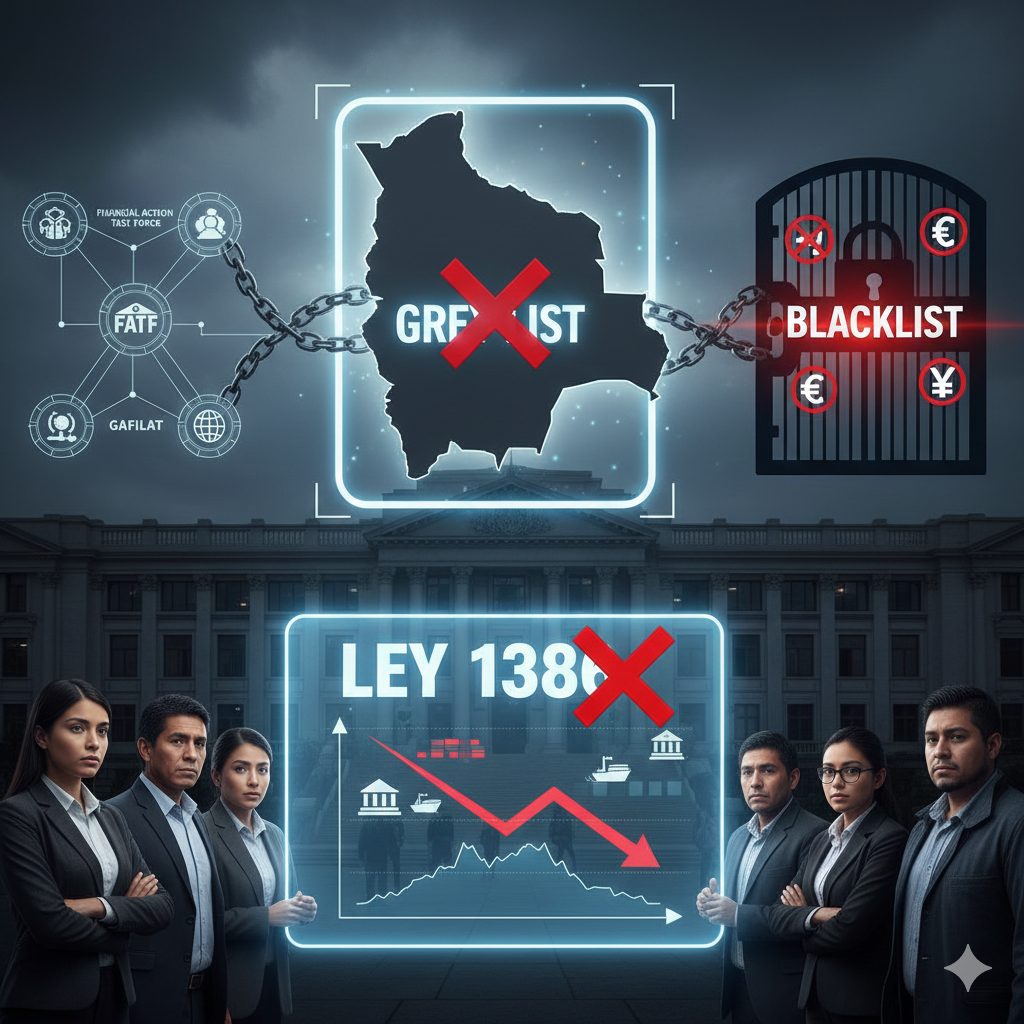
Recently, Bolivia was included on the “Grey List” of the Financial Action Task Force (FATF), which implies a period of increased monitoring by this body and a commitment by the country to address the deficiencies identified in its system for preventing Money Laundering (ML) and Terrorist Financing (TF).
The FATF is an international body that sets global standards to combat ML, TF, and the proliferation of weapons of mass destruction. To this end, it issues recommendations, technically evaluates countries, conducts continuous monitoring, and classifies them into lists: the “Black List,” which includes non-cooperative countries, and the “Grey List,” which groups those that are under observation or in the process of implementing these recommendations.
The implementation of these standards is channeled through regional bodies such as the Financial Action Task Force of Latin America (GAFILAT), which acts as the FATF’s technical arm in the region. Bolivia is a member of GAFILAT and therefore has the obligation to adapt and implement these international guidelines.
In Bolivia’s case, the country was first included on the Grey List in 2011 and managed to exit in 2013 after implementing a comprehensive action plan that took two years, in line with the timeframe required by countries such as Croatia and the United Arab Emirates, and shorter than Pakistan, which required four years. This demonstrates that it is a process that requires time, but above all, political will.
Such political will has been absent in Bolivia. Despite repeated warnings, between 2021 and 2023 the Plurinational Legislative Assembly (ALP) repealed Law No. 1386 on the National Strategy to Combat the Laundering of Illicit Gains and the Financing of Terrorism, and blocked two subsequent draft laws. This led to the country’s re-inclusion on the Grey List, despite having complied with nearly 90% of the FATF’s observations.
The FATF’s main observation regarding Bolivia is that the country must continue working to implement its action plan through the application of special investigative techniques in cases involving ML and TF crimes, which requires attention through actions with the force of law.
If the ALP’s inaction persists in approving the required regulations, Bolivia faces the risk of being placed on the FATF Black List. This would entail immediate effects, such as isolation from the international financial system, restrictions on commercial and financial operations, loss of banking correspondent relationships, and deterioration in the country risk perception. Under this scenario, immediate political will and a firm commitment to the legislative agenda are required to preserve financial stability and protect the country’s economic interests.
Author: Walter Marañon Quiñones
You can also read this article in:



Share this article: