Credit Constraints in Bolivia
Access to financing is a fundamental component for economic development, especially in developing countries, as it allows for promoting investment, fostering innovation, modernizing productive sectors, and improving infrastructure, thereby contributing to sustainable growth and improving the population’s standard of living.
The concept of credit constraints refers to the limitations faced by consumers and businesses in accessing financing in financial markets. These constraints can arise due to factors such as information asymmetry between lenders and borrowers, high transaction costs, or internal policies and regulations that make issuing credit difficult, among others.
From a macroeconomic perspective, these limitations reduce investment capacity, slow economic growth, and increase vulnerability to crises. External financing is not only essential for executing long-term projects but also for managing economic difficulties, stabilizing domestic markets, and smoothing economic cycles.
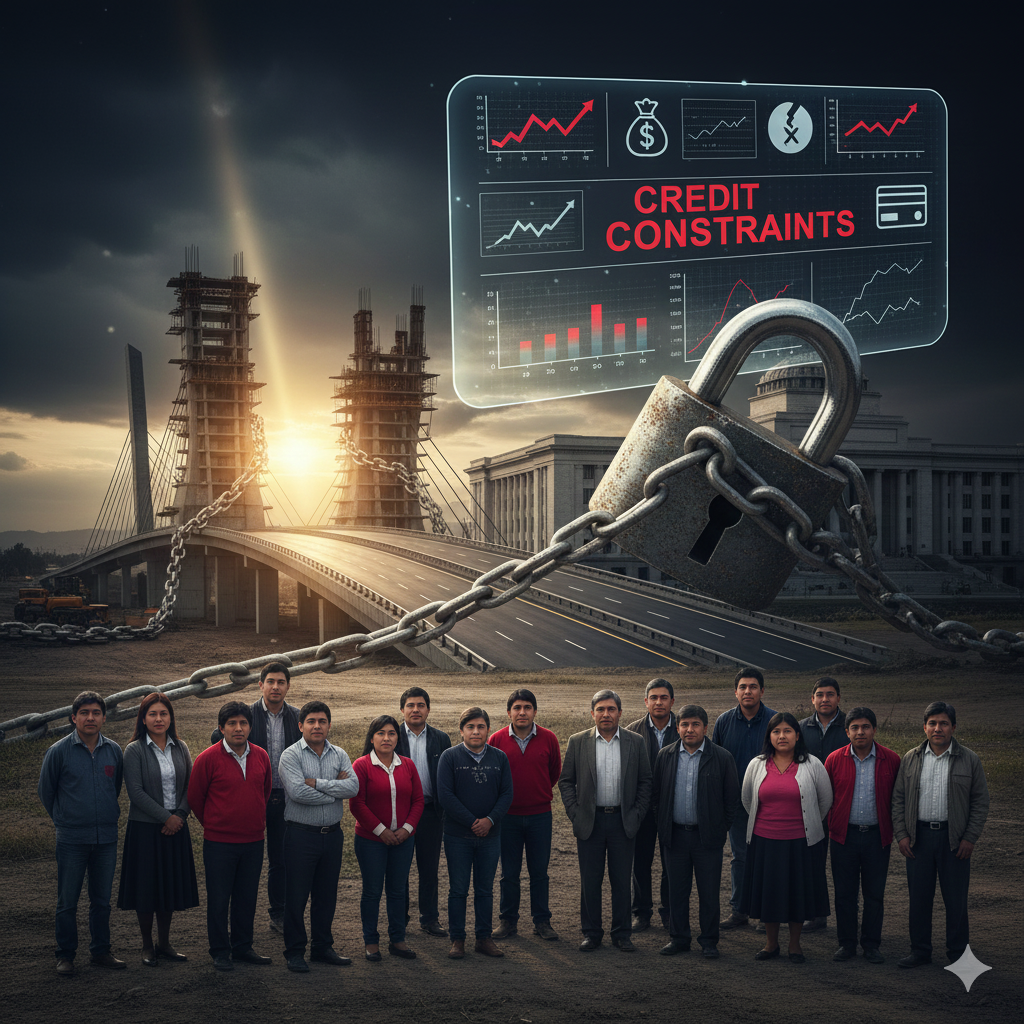
In this context, Bolivia faces a critical situation of credit constraints, induced by the legislature’s refusal to approve the contracting of loans. This stance has created an environment of uncertainty that hinders the execution of development projects and weakens the confidence of national and international investors. As a result, access to key resources for financing strategic initiatives in infrastructure, productive transformation, and economic modernization is compromised.
The resulting decrease in liquidity limits the State’s ability to respond to immediate economic challenges, reflected in lower implementation of public policies, an impact on international reserves, and growing pressure on public finances, negatively affecting the country’s overall economic dynamism.
It is essential to recognize that any plan aimed at stabilizing the economy requires a solid financing base. Legislative blocking of loans, far from being an effective fiscal control measure, contradicts political discourse aimed at economic recovery and directly harms the Bolivian population, which is already beginning to experience the effects of this resource reduction.
Reversing this situation requires political will, constructive dialogue, and a population-centered approach. It is urgent to reach consensus that allows the approval of necessary loans under principles of transparency, efficiency, and fiscal responsibility. Only through coordinated and strategic action can the Bolivian economy be reactivated, ensuring sustainable development for all Bolivians.
Author: Walter Marañon Quiñones
You can also read this article in:




Share this article: